The Codeability Index
50 trading strategies traders actually use, scored on one question: can a computer test the rule as it's published?
Before you can find out whether a strategy works, it has to be written down precisely enough for a computer to follow. We took fifty well-known ones (ICT and smart-money models, price action, support and resistance, supply and demand, breakouts, Fibonacci, Elliott Wave, harmonics, volume profile, order flow, news trading, scalping and the big indicator combos) and read one public definition of each: the creator's own video or page where there is one, otherwise a named restatement or a standard teaching page.
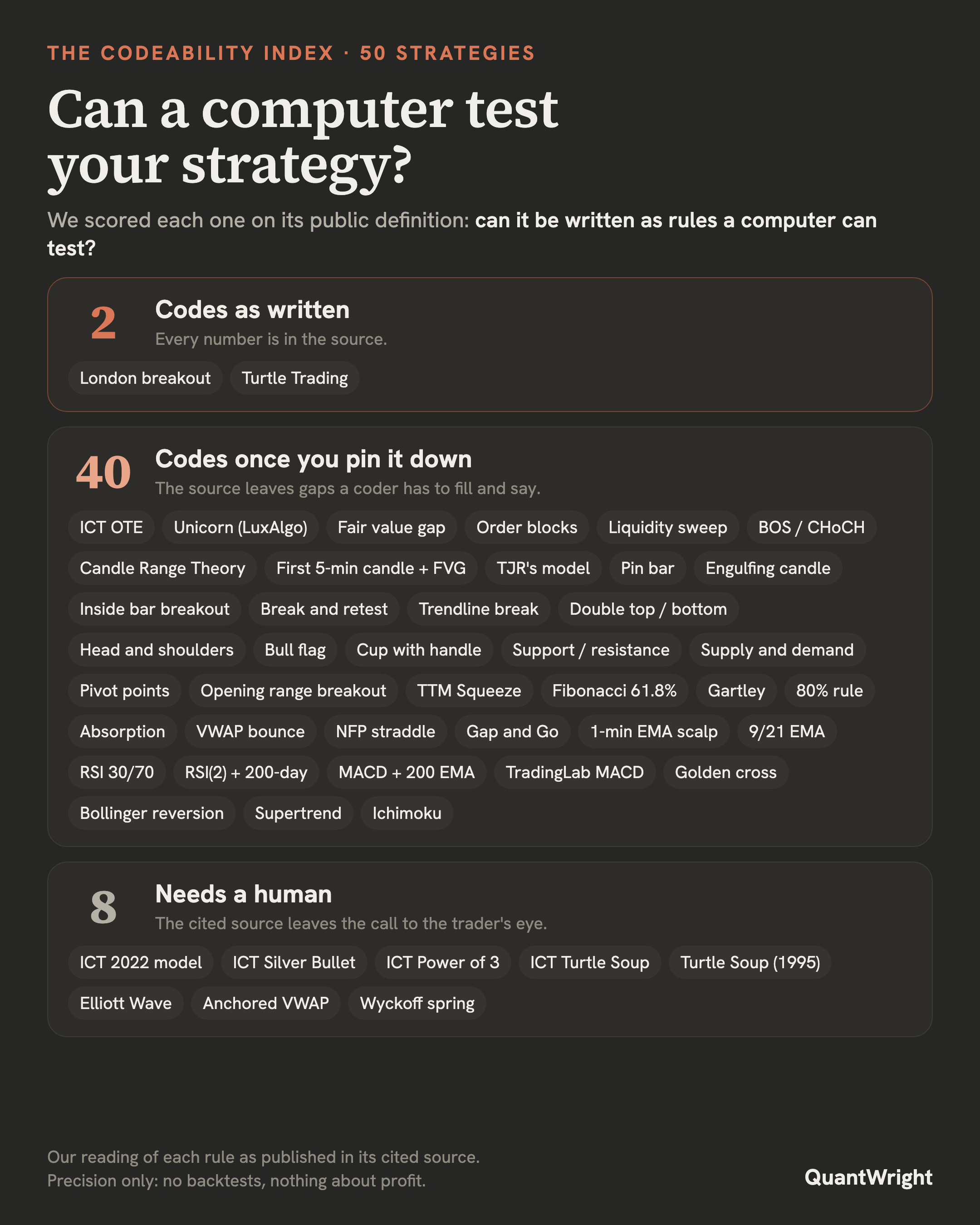
2 code exactly as written · 40 code once you fill the gaps · 8 need a human
What the sources leave out: the exact entry is pinned down in 8 of 50, the stop in 14, the exit in 9.
The five things a computer has to know
Every backtest needs the same five answers, on every bar:
- Setup: what has to be true before a trade is possible?
- Entry: what exactly triggers it, which way, at what price?
- Stop: where is the trade wrong?
- Exit: where or when does it take profit or close?
- Filter: anything else that must hold: trend, session, news?
If your rule answers all five with numbers, a computer can test it on hundreds of trades. If one answer is "you'll know it when you see it", it can't, yet.
What the tiers mean
- Codes as written: every answer is in the source. Two people coding it get the same trades.
- Codes once you pin it down: the source leaves gaps, like "what counts as a strong candle?". A coder has to choose a number and say so. Choose a different number and you've tested a different strategy.
- Needs a human: the source leaves a trade-deciding call, usually which side to trade, to the trader's read. Any code has to add a rule the source doesn't give, so it tests that rule too.
A tier says how precisely a rule is written down in the source we cite. It says nothing about whether the strategy makes money or how well its creator trades it, and "needs a human" isn't a knock: plenty of traders want judgement in their method. Where a creator says the full rules are in a paid course or a book, the row says so: we scored the public source.
The index
01ICT 2022 Mentorship model
- Whose definition
- ICT
- Tier
- Needs a human
- Gaps
- Which side to trade? The setup starts 'if we're bearish' and must align with 'your bias' and 'the narrative of the day'. This lecture gives no rule for either; it points viewers to the 41 videos of the 2022 free mentorship [22:38], which we did not score.
- How many bars on each side make the recent low or high whose break is the market structure shift?
- What size of move counts as 'displacement', and how close must highs be to count as 'relative equal'?
- Which opposing target is the exit, and what share is closed at each one?
- Why
- Raid, shift and gap are observable, but the side follows your bias, and this lecture gives no rule for bias.
Quotes (9)
02ICT Silver Bullet
- Whose definition
- ICT
- Tier
- Needs a human
- Gaps
- Where is price going next (which draw on liquidity)? The source lists many and leaves the pick to the trader.
- Where inside the fair value gap is the entry?
- Where is the stop? Not given in this video; ICT refers to 'the rules I teach with all of my models' [10:46].
- Is the exit the draw on liquidity or a fixed five or ten handles?
- Is the 10-handle (15-pip) minimum range required, given 'we don't require that'?
- Why
- Direction rests on 'knowing where price is going to go', the trader's own read of the next draw on liquidity.
Quotes (6)
03ICT Optimal Trade Entry (OTE)
- Whose definition
- ICT
- Tier
- Codes once you pin it down
- Gaps
- Which short-term swing low and high set the Fibonacci range?
- Which level in the 62-79% band is the limit order?
- How many pips below the range low is the stop, and exactly when does it move?
- How much is closed at each target and how many partials are taken?
- How far must price trade through the previous day's high before the setup counts?
- Why
- Window, 62-79% band, stop below the range low and fib targets are given; swing choice, exact level and partials are open.
Quotes (6)
04ICT Power of Three (AMD)
- Whose definition
- ICT
- Tier
- Needs a human
- Gaps
- Is the day bullish or bearish? The source leaves that to the trader's read ('anticipatory price skills').
- What counts as accumulation around the open, and how deep must the manipulation run?
- What triggers the buy: touching the open, the sweep low, or a turn after the sweep?
- Where is the stop? Not given in this video.
- Where does the trade close?
- Why
- The side comes from whether the trader is 'bullish' or 'bearish', and this video gives no rule for deciding that.
Quotes (5)
05ICT Turtle Soup
- Whose definition
- ICT
- Tier
- Needs a human
- Gaps
- How do you tell that a 'sell program' (or 'buy program') is under way? The full lecture describes it as the market 'algorithmically spooling in a direction' [42:39] and ICT writes down which one he expects 'based on what I think is likely to happen' [114:31]; no observable test.
- What makes a reversal a 'change in the state of delivery'?
- Which edge of the gap is the entry, and is the second tranche required?
- Which of the two stops is used?
- Where does the trade exit? Not given in the clip, nor in the same segment of the full lecture.
- Why
- Everything hangs on reading whether a 'sell program' is under way; neither the clip nor the full lecture gives an observable test.
Quotes (7)
06ICT Unicorn
- Whose definition
- LuxAlgo's reading (no ICT primary found)
- Tier
- Codes once you pin it down
- Gaps
- What counts as an 'obvious' prior low and how far must it be swept?
- What counts as 'energetic' displacement, and which candles make the breaker?
- Where inside the overlap is the limit order?
- Which stop and which target: the page gives two options for each.
- Which session window is required, and is any higher-timeframe bias needed?
- Why
- Sweep, shift, overlap and a limit inside the zone are clear; 'obvious' low, 'energetic' push, stop, target and window are not.
Quotes (6)
07Fair value gap (FVG) entry
- Whose definition
- generic
- Tier
- Codes once you pin it down
- Gaps
- How wide must the middle candle, or the gap itself, be before it counts (minimum size in ATR or percent)?
- Where inside the gap do we enter: first touch, midpoint or far edge?
- Is any confirmation needed after price trades back into the gap, and which one?
- Where is the profit target?
- Which direction or context filter (premium/discount, structure break) is required?
- Why
- Gap is exact and stop is the far edge; entry point, minimum size, exit and context are not given.
Quotes (5)
08Order block entry
- Whose definition
- generic
- Tier
- Codes once you pin it down
- Gaps
- What counts as a 'significant reaction' that makes a zone, and how wide is the zone?
- Which entry type, and which reversal candle patterns, confirm it?
- How far is 'slightly beyond' the zone for the stop?
- Which profit target: nearby support or resistance, or a fixed risk-to-reward number?
- Which confluence is required, and how is 'the trend' measured?
- Why
- Every slot has a hole: 'significant reaction', 'signs of a reversal', 'slightly beyond' and 'nearby' levels all need numbers.
Quotes (6)
- Setup: “looking for areas where the price experienced significant movement or sudden changes in direction”page text, What is an order block?
- Entry: “shows signs of a reversal, such as the formation of reversal candlestick patterns (e.g., shooting star, hammer, or engulfing patterns)”page text, 3. Trade entries
- Stop: “Place a stop loss order slightly beyond the order block”page text, 5. Set stop loss and profit targets
- Exit: “Set profit targets based on nearby support and resistance levels or by using a risk-reward ratio that suits your risk tolerance”page text, 5. Set stop loss and profit targets
- Filter: “you can combine order blocks with other technical analysis tools, such as trendlines, moving averages, Fibonacci levels, or chart patterns”page text, 4. Look for confluence
- Decisive: “looking for areas where the price experienced significant movement or sudden changes in direction”page text, What is an order block?
09Liquidity sweep (stop hunt) reversal
- Whose definition
- generic
- Tier
- Codes once you pin it down
- Gaps
- Which levels count as liquidity, and how many bars on each side define a swing high or low?
- Must price close back inside on the sweeping candle, or within a few bars (how many)?
- What is the entry trigger: displacement, a lower-timeframe change of character, or a retrace into a gap or order block?
- Where is the profit target?
- Which levels, sessions or higher-timeframe bias are required?
- Why
- Sweep is defined by a close back inside and the stop sits beyond the wick; levels, trigger, exit and filters vary.
Quotes (5)
10Break of structure / change of character
- Whose definition
- generic
- Tier
- Codes once you pin it down
- Gaps
- How many bars make a swing, and which swing must be broken (latest, or the one that made the extreme)?
- How many swings make the prevailing trend?
- Do we enter on the break, or on a retrace after it (into what)?
- Is displacement or a prior liquidity sweep required, and how big?
- Where are the stop and the exit?
- Why
- The structure break is clear, but swing size, entry point, stop, exit and context are not given.
Quotes (5)
11Candle Range Theory (CRT)
- Whose definition
- Romeotpt
- Tier
- Codes once you pin it down
- Gaps
- Which timeframe's candle is candle one, and what counts as a 'clean' range?
- Must candle two's wick pierce candle one's range and close back inside it, and by how much?
- Where exactly is the entry relative to the candle-three open, and which of the listed entry types?
- Where is the stop? Not given in this video (it says a trade 'never got stopped out' [37:48] without saying where the stop sat).
- At the 50% level is the whole position closed, and where does any remainder exit?
- Why
- Three-candle sequence and 50% target are named; the stop, the turtle-soup test and the entry offset are left open.
Quotes (6)
12First 5-minute candle + FVG
- Whose definition
- Jesse Rogers, Casper Trading
- Tier
- Codes once you pin it down
- Gaps
- Must the range-breaking candle be the middle candle of the gap, and how far outside the range must the gap sit?
- When the first break has no gap, what counts as price returning to the range (a touch of the level or a close inside) and may any gap size trigger the retest entry?
- Until what time may an entry be taken, and is it one trade a day or more?
- Is 'the base of the candle' the candle's wick extreme or its body edge?
- Why
- Range, stop and 2:1 target are exact; how the gap relates to the break, retest rules and time window are not.
Quotes (6)
13TJR's model
- Whose definition
- TJR
- Tier
- Codes once you pin it down
- Gaps
- What is a 1-hour high or 4-hour high, and which sessions count as draws on liquidity?
- How is the most recent high or low picked for a break of structure (bars on each side of a swing)?
- Which fair value gap must be inverted, and is the 5-minute equilibrium or gap-fill step required?
- Which high is 'the second high' for the stop?
- Which draw is the target, and are partials and a break-even move part of the rule?
- How are ES and NQ 'aligned', and what is the cut-off time?
- Why
- Sequence is clear (sweep, 5-minute break, 1-minute break back) but swing size, levels, stop, targets and cutoff time are open.
Quotes (6)
14Pin bar reversal
- Whose definition
- generic
- Tier
- Codes once you pin it down
- Gaps
- How long must the tail be, as a share of the bar's range, and how small must the body be?
- Which levels count as support, resistance, swing point or rising average, and how many bars make a swing?
- Do we enter on a break of the pin bar's extreme or after the next bar closes in its direction?
- How far beyond the tail does the stop go?
- Where does the trade exit?
- Why
- Shape and level come as 'common' conventions, not fixed numbers; the page gives no exit and leaves the stop buffer optional.
Quotes (4)
15Engulfing candle reversal
- Whose definition
- generic
- Tier
- Codes once you pin it down
- Gaps
- Which entry: break of the engulfing candle's high, its close, or the next day?
- Must the engulfing candle cover only the first body or the first candle's whole range?
- What counts as the downtrend before the pattern?
- Where does the stop go?
- What is the target or exit?
- Why
- Page defines the engulf two ways; the downtrend, entry timing, stop and exit are all left open.
Quotes (6)
16Inside bar breakout
- Whose definition
- generic
- Tier
- Codes once you pin it down
- Gaps
- Do we trade both breakout directions or only with the primary trend?
- How is the primary trend measured?
- Where does the stop go?
- Where does the trade exit?
- How long do the breakout orders stay live?
- Why
- The inside-bar test is exact; stop and exit are missing, 'primary trend' is undefined, and entry has two options.
Quotes (4)
17Break and retest
- Whose definition
- generic
- Tier
- Codes once you pin it down
- Gaps
- What counts as a structural high or low, and a break of it?
- How near and how soon must the retest come?
- What are a strong candle, an indecision candle and a wick rejection, and how many rejections are 'multiple'?
- When exactly is the entry placed after the confirming candle?
- Where is the stop, and is the target 1R, 2R or 3R?
- How is sideways told from a clear trend?
- Why
- Break, retest and candle pattern are described in words only; entry timing, stop and the 1-2-3 reward ratio are left open.
Quotes (5)
18Trendline break
- Whose definition
- generic
- Tier
- Codes once you pin it down
- Gaps
- Which points anchor the line, and how is a pivot defined?
- Is the entry a break of the line or a bounce near it, and how near?
- What counts as a breach: a touch or a close beyond, and by how much?
- Is there a profit target or only a breach exit?
- Why
- Page teaches drawing a trendline, not a break trade: no break entry, stop distance or target; anchor points are a choice.
Quotes (5)
19Double top / double bottom
- Whose definition
- generic
- Tier
- Codes once you pin it down
- Gaps
- How is a swing low or peak defined, and are the two within 3% or 4%?
- Which entry: first daily close beyond the middle level, a retest with confirmation, or with divergence?
- Is the target one or two times the pattern height?
- What replaces the fundamentals check, and how is the prior trend measured?
- Why
- Entry level and second-low stop are given; swing points, 3% versus 4% tolerance, two target sizes and a fundamentals test are not.
Quotes (6)
- Setup: “No, there is room to play with the relative levels of the lows, though they should be within 3% to 4% of each other.”page text, Investopedia, double bottom
- Entry: “A long position should be taken on a daily close above the price level of the high of the first rebound”page text, Investopedia, double bottom
- Stop: “with a stop loss at the second low in the pattern”page text, Investopedia, double bottom
- Exit: “A more aggressive interpretation of the pattern suggests a target at two times the distance between the lows and the intermediate high.”page text, Investopedia, double bottom
- Filter: “The pattern should be validated by a change in market fundamentals for the security itself (for example, better earnings), as well as the sector”page text, Investopedia, double bottom
- Decisive: “though they should be within 3% to 4% of each other”page text, Investopedia, double bottom
20Head and shoulders
- Whose definition
- generic
- Tier
- Codes once you pin it down
- Gaps
- How much higher is the head, and how close in height are the shoulders?
- How is a peak defined and the neckline drawn when it slopes?
- Is a breakout a close beyond the neckline, and is a retest entry allowed?
- Which high and low measure the profit target?
- How long a prior uptrend is needed?
- Why
- Neckline-break entry, right-shoulder stop and pattern-height target are named; 'substantially above', 'similar height' and long trends have no numbers.
Quotes (6)
21Bull flag
- Whose definition
- generic
- Tier
- Codes once you pin it down
- Gaps
- How sharp is the pole and how tight is the channel; how are the parallel lines fitted?
- How far beyond the lower line does the stop go?
- Which target: channel width or flagpole height?
- Which market trend must agree?
- Why
- Entry is a close above the upper line; 'sharp', 'tight', stop distance, two target sizes and 'market trends' lack numbers.
Quotes (6)
22Cup with handle
- Whose definition
- William O'Neil (Investor's Business Daily)
- Tier
- Codes once you pin it down
- Gaps
- What is 'light' volume in the handle?
- How is the left-side peak found and the prior uptrend measured?
- Is breakout volume 40% or 50% above average, and average of what?
- Is the stop 7% or 8%?
- What exits the trade?
- Why
- Shape and buy point have numbers (30%, 15-30%, 7 weeks, peak plus 10 cents); 'light' volume, stop and exit are not.
Quotes (5)
23Support and resistance bounce
- Whose definition
- generic
- Tier
- Codes once you pin it down
- Gaps
- What makes a level: how many touches, how far apart, which level type?
- How wide is the zone around a level?
- Is the entry on touch or after a reversal candle?
- What counts as breaking through (stop)?
- Where does the trade exit?
- Why
- Levels have observable tests (touches, trendlines) but no zone width; the page gives no firm bounce trigger, stop distance or target.
Quotes (5)
- Setup: “To identify support or resistance, you have to look back at the chart to find a significant pause in a price decline or rise.”page text, The Basics
- Entry: “place short trades as the price touches the upper trendline and long trades as the price reverses to touch the lower trendline”page text, Trading Ranges
- Stop: “If the price moves in the wrong direction (breaks through prior support or resistance levels), the position can be closed at a small loss.”page text, Why Support and Resistance Matter
- Exit: “those price levels can serve as potential entry or exit points”page text, Why Support and Resistance Matter
- Decisive: “To be a valid trendline, the price needs to touch the trendline at least three times.”page text
24Supply and demand zones
- Whose definition
- generic
- Tier
- Codes once you pin it down
- Gaps
- How strong must the departure be, and how many candles may the base have?
- Are the zone edges set by wicks or bodies (the page says 'conventions vary')?
- Limit order at the edge, or wait for a reaction (what reaction)?
- What grade or freshness is required, and which of the four formations are traded?
- Which edge of the next opposing zone is the target?
- Why
- Stop is the far edge of the zone; zone size, entry style, target and quality grade are not fixed.
Quotes (6)
25Floor pivot points
- Whose definition
- generic
- Tier
- Codes once you pin it down
- Gaps
- Which pivot levels trigger a trade, and how near must price be?
- Bounce, breakout or failed-breakout entry?
- How far beyond the next level does the stop go?
- Which level is the target?
- Which trend or confirming indicator must agree?
- Why
- The levels come from an exact formula; which level to trade, how near, the entry trigger, stop and target are only examples.
Quotes (6)
- Setup: “Pivot points help traders identify support and resistance levels by calculating the average of the previous period's high, low, and closing prices.”page text, Definition
- Entry: “Traders may enter long positions near support levels, expecting a price bounce”page text, Using Pivot Points in Trading
- Stop: “setting a stop loss just above the R1 level”page text, Practical Examples of Pivot Points
- Exit: “targeting a move down to S2”page text, Practical Examples of Pivot Points
- Filter: “If the price opens above the PP and remains above it, traders interpret this as an uptrend.”page text, Using Pivot Points in Trading
- Decisive: “Traders may enter long positions near support levels, expecting a price bounce”page text, Using Pivot Points in Trading
26Opening range breakout (5-min)
- Whose definition
- Zarattini & Aziz (paper)
- Tier
- Codes once you pin it down
- Gaps
- How close is 'about the same': what first-bar open-to-close gap means no trade?
- Does 'rises (falls) during the first 5-minute interval' mean first-bar close above (below) its open? (we read it that way)
- Why
- First 5-minute candle sets direction, stop and 10x target are exact; only 'about the same' (no-trade candle) has no number.
Quotes (5)
27London / Asian-range breakout
- Whose definition
- generic
- Tier
- Codes as written
- Gaps
None. Conventions, not gaps:
- Daily ATR(14) smoothing (Wilder's or a simple average of true range) and using only completed days are the tester's conventions.
- Why
- Every number is given: Asian range 00:00-07:00 UTC, 15-minute close entry, far-side stop, 1R target, 12:00 exit, ATR band.
Quotes (6)
28Turtle Trading (Donchian breakout)
- Whose definition
- the Turtles (Curtis Faith's published rules)
- Tier
- Codes as written
- Gaps
None. Conventions, not gaps:
- The document gives two complete systems (System 1: 20-day breakout in, 10-day out; System 2: 55-day in, 20-day out); we scored System 1.
- Its 'Whipsaw' stop is an alternate that 'a few Turtles traded', not System 1's stop.
- Picking among several markets' signals ('buying strength') matters only for a portfolio; a one-market test does not use it.
- Tick size and intraday fills at the breakout level are the tester's conventions.
- Why
- 20-day breakout in, 10-day breakout out, 2N stop, N defined by formula; System 2 uses 55 in, 20 out.
Quotes (6)
- Setup: “Thus a 20-day breakout would be defined as exceeding the high or low of the preceding 20 days.”page text, Chapter 4, Entries: Breakouts
- Entry: “Turtles entered positions when the price exceeded by a single tick the high or low of the preceding 20 days.”page text, Chapter 4, Entries: System 1 Entry
- Stop: “Turtle stops were set at 2 N below the entry for long positions, and 2 N above the entry for short positions.”page text, Chapter 5, Stops: Stop Placement
- Exit: “The System 1 exit was a 10 day low for long positions and a 10 day high for short positions.”page text, Chapter 6, Exits: Turtle Exits
- Filter: “System 1 breakout entry signals would be ignored if the last breakout would have resulted in a winning trade.”page text, Chapter 4, Entries: System 1 Entry
- Decisive: “N is simply the 20-day exponential moving average of the True Range, which is now more commonly known as the ATR.”page text
29Turtle Soup (the original)
- Whose definition
- Connors & Raschke (book), as restated by Paolo Pezzutti (Stocks & Commodities, 2005) and Alexander Puzanov (MQL5, 2016)
- Tier
- Needs a human
- Gaps
- Puzanov (MQL5) reports that the authors want the trader to 'analyze how the price approaches the channel borders', and that they 'do not provide any details'; Pezzutti (S&C) lists 'Your judgment about market conditions'. What observable test would stand in for that read?
- How many days must pass since the previous 20-day low: 'at least four days earlier' (S&C) or 'at least three days' (MQL5)?
- How many ticks (5 to 10) above the previous 20-day low is the buy-stop, and how long does the order stay live?
- What are the trailing-stop numbers (none given by either restatement)?
- Plus One variant: entry 'at the earlier 20-day low' (S&C, no offset) or offset like the base pattern (MQL5)? Stop: S&C gives none, MQL5 uses the two-day extreme; MQL5 also allows re-entry at the same level after a first- or second-day stop-out.
- Are '20-day' lows counted on daily bars only? (S&C's own example runs on a 60-minute chart)
- Why
- Entry offset is a range and the trailing stop has no numbers; Puzanov reports that the authors warn against purely mechanical following.
Quotes (6)
- Setup: “They believe it is necessary to analyze how the price approaches the channel borders and how it behaves after testing the limits.”page text, MQL5 article (A. Puzanov, 2016)
- Entry: “After the new low has occurred, place an entry buy-stop five to 10 ticks above the previous 20-day low.”page text, Stocks & Commodities (P. Pezzutti, 2005)
- Stop: “The stop-loss is one tick under today's low.”page text, Stocks & Commodities (P. Pezzutti, 2005)
- Exit: “The authors suggest using a trailing stop for a trade that might last a few hours or even a few days.”page text, Stocks & Commodities (P. Pezzutti, 2005)
- Filter: “Your judgment about market conditions (for example, force of the trend, volatility, and so forth)”page text, Stocks & Commodities (P. Pezzutti, 2005)
- Decisive: “Connors and Raschke warn against purely mechanical following of rules of any of the strategies described in the book.”page text, MQL5 article (A. Puzanov, 2016)
30TTM Squeeze
- Whose definition
- John Carter
- Tier
- Codes once you pin it down
- Gaps
- Which bar of the squeeze is the entry bar, and what is momentum trending higher/lower in numbers?
- Raw 12-period momentum or the smoothed histogram (smoothing not given)?
- What ends the trade: 'loses momentum' or the TTM trend bar changing colour, and how is the stop trailed after the scale-outs?
- Are the higher-time-frame check and the TTM Wave A/B/C filters part of the rules or optional extras?
- Is the 1 ATR(14) stop measured from the entry price? (read that way)
- Why
- Default-setting squeeze and a 1 ATR(14) stop are stated; entry bar, 'loses momentum' exit and extra filters are not.
Quotes (6)
31Fibonacci retracement (61.8%, "golden pocket")
- Whose definition
- generic
- Tier
- Codes once you pin it down
- Gaps
- How are the swing high and swing low chosen?
- Which retracement level (or levels) do we trade?
- What confirmation is needed after price reaches the level?
- How far beyond the next level is the stop?
- Which extension, or the previous high, is the target?
- How is the trend decided?
- Why
- Level formula is exact, but swing points, which level, confirmation, stop distance and target are all left open.
Quotes (6)
- Setup: “Once the trend is identified, traders should choose the swing high and swing low as reference points.”page text, How Fibonacci Retracement Levels Work
- Entry: “In an uptrend, traders look for price pullbacks, as well as bullish confirmation, such as candlestick patterns or relative strength index indicators”page text, Applications in Trading
- Stop: “traders place stop-loss orders just beyond the next Fibonacci level”page text, Applications in Trading
- Exit: “Key extension levels include 100%, 161.8%, and 261.8%.”page text, Applications in Trading
- Filter: “To apply the retracement levels, traders need to identify the market trend.”page text, How Fibonacci Retracement Levels Work
- Decisive: “the subjectivity in selecting swing points, as different traders choose different high and low points”page text
32Elliott Wave
- Whose definition
- Frost & Prechter / Elliott Wave International
- Tier
- Needs a human
- Gaps
- Which of the two or more valid wave counts is the right one? The page asks the reader to 'carefully assess the probability of each interpretation' and calls 'preferred' the count that satisfies the largest number of guidelines; this page doesn't list the guidelines.
- Where does the wave count say to enter?
- Where is the count wrong (stop)?
- Where does the trade exit?
- Why
- The page says two or more valid wave counts usually exist and the reader must 'carefully assess the probability of each'; its 'preferred' count is the one that satisfies the largest number of guidelines, which this page doesn't list.
Quotes (5)
33Gartley pattern
- Whose definition
- Scott Carney
- Tier
- Codes once you pin it down
- Gaps
- What tolerance applies to the 0.618 and 0.786 ratios?
- How are the X, A, B, C and D points picked?
- Is the entry at D on touch or after a reversal candle?
- Is the stop beyond X, and by how much?
- Where does the trade exit? Not on this page, which is an excerpt from Carney's book The Harmonic Trader and points to his paid membership and course for more; we scored the public page.
- Why
- Ratios are given (B at 0.618, D at 0.786 of XA); tolerance, swing points, entry, stop and exit are not on this page.
Paraphrases (4)
34Value area "80% rule"
- Whose definition
- generic (Market Profile)
- Tier
- Codes once you pin it down
- Gaps
- Which value area (TPO or volume profile, percentage, bin size, regular hours only)?
- Classic two 30-minute periods inside, or relaxed acceptance by time and volume (measured how)?
- Does 'inside' mean every print or the closes?
- Which open types, if any, are skipped?
- Why
- Outside-value open, stop and opposite-boundary target are exact; value-area method, acceptance test and open-type filter vary.
Quotes (6)
35Absorption (footprint)
- Whose definition
- generic
- Tier
- Codes once you pin it down
- Gaps
- How close must touches be to count as one level, and how many touches are needed?
- What is 'clearly elevated' volume and 'narrow spread' in numbers?
- What counts as price leaving the level 'with ease', and where is the entry?
- Where are the stop and the exit?
- Is any range, trend or session context required?
- Why
- Page describes a behaviour, not a trade: touches, volume and 'with ease' need numbers; stop, exit and filter are absent.
Quotes (3)
36VWAP bounce / reclaim
- Whose definition
- TradeZella (written rules)
- Tier
- Codes once you pin it down
- Gaps
- What counts as a 'strong candle' and 'above-average volume' (average of how many bars)?
- Bounce entry: close of the bullish candle or break of its high; 1-minute or 5-minute chart?
- Reclaim entry: what is the 'first pullback that holds above VWAP'?
- Reclaim stop: 0.15% below VWAP or below the reclaim candle's low?
- How is the profit target found ('prior swing high', 'morning high or prior resistance') and how is the remainder trailed?
- Which days and clock window are allowed ('clean trending days', 10:00 AM to 2:00 PM ET, avoid the first 15 minutes)?
- Why
- Time and distance numbers are given, but 'strong candle', 'above-average volume', 'or' stops and swing-high targets need choices.
Quotes (6)
37Anchored VWAP
- Whose definition
- Brian Shannon
- Tier
- Needs a human
- Gaps
- Where do we anchor: which event, swing low or gap counts? The interview calls it 'the art'; the host says anchoring is 'definitely in your book as well' [50:28], and the video description links Shannon's book. We scored the interview.
- Which 'level of interest' qualifies: how many of AVWAP, 50-day average and Fibonacci level must coincide?
- What is 'buy strength after the touch' as a rule: which break, on which time frame?
- What is the 'most recent and relevant higher low' for the stop?
- Where and how much is sold, and how is the stop trailed (no price target)?
- Which five-day moving average, and how is 'declining' measured?
- Why
- Where to anchor is called 'the art'; entry, stop and exits depend on reading higher lows and 'strength'.
Quotes (7)
38Wyckoff spring
- Whose definition
- generic (Wyckoff method)
- Tier
- Needs a human
- Gaps
- Is this trading range accumulation or distribution? The page asks the analyst to 'anticipate and correctly judge the direction and magnitude of the move out of a TR'; its phases and nine buying tests are guidelines for that judgement, not a rule that decides it.
- What counts as a spring: how far below the range's support, how quickly back inside, and what is 'low-volume'?
- How large is the 'partial long position', and when is the rest added?
- Where is the stop? The page says to put a stop in place 'and trail it, as appropriate', with no level.
- Where is the exit? The point-and-figure targets 'should never be looked upon as exact points of where a trend will change'.
- Is the market-index turn in step 5 required, and how is it read?
- Why
- The spring itself is observable, but the method asks the analyst to 'correctly judge the direction' of the move out of the range; the page gives guidelines, not a rule.
Quotes (6)
- Setup: “A successful Wyckoff analyst must be able to anticipate and correctly judge the direction and magnitude of the move out of a TR.”page text, Wyckoff Schematics
- Entry: “A low-volume spring (or a low-volume test of a shakeout) indicates that the stock is likely to be ready to move up, so this is a good time to initiate at least a partial long position.”page text, Accumulation: Wyckoff Phases
- Stop: “Put your stop-loss in place and trail it, as appropriate, until you close out the position.”page text, A Five-Step Approach to the Market
- Exit: “These targets should never be looked upon as exact points of where a trend will change”page text, Wyckoff Point and Figure (P&F) Count Guide
- Filter: “This assessment should help you decide whether to be in the market at all and, if so, whether to take long or short positions.”page text, A Five-Step Approach to the Market
- Decisive: “A successful Wyckoff analyst must be able to anticipate and correctly judge the direction and magnitude of the move out of a TR.”page text, Wyckoff Schematics
39News breakout (NFP straddle)
- Whose definition
- generic
- Tier
- Codes once you pin it down
- Gaps
- Which stretch of bars defines the range before the release ('at least 20 minutes before')?
- The 20-pip stop: measured from which level, and exactly 20?
- Is the target exactly the range width, and what happens to a trade that reaches no target and no stop?
- Which news releases count, and is there a maximum range for placing the orders?
- After one side triggers and loses, does the other side stay live (the page says yes) and for how long?
- Why
- Entry levels are the range high and low, but range window, stop reference, target and which news are loosely worded.
Quotes (6)
40Gap and Go
- Whose definition
- Ross Cameron, Warrior Trading
- Tier
- Codes once you pin it down
- Gaps
- Gap-size cut-off: 5% minimum or 20% 'usually'?
- Which entry: break of the pre-market high (touch, close, or anticipated), or one of his other setups (first and second pullback, red-to-green, opening-range break)?
- Where is the stop? Not given in this public video; Ross Cameron says where to get in and out is taught in his Warrior Pro classes [01:46]. The description also points to a free class (registration needed) on how he determines entries and exits; we did not score it.
- How is the trade exited? The video says 'either to take profit or to hold for a bigger move' [18:25] and points to the classes for the rest.
- Float, price and news requirements are preferences ('is better'), not cut-offs.
- Why
- Break of the pre-market high is one named setup; gap size, stop, exit and float cut-offs are open. The source says the full rules are in the paid course; we scored the public one.
Quotes (7)
411-minute scalping (EMA + stochastic)
- Whose definition
- generic
- Tier
- Codes once you pin it down
- Gaps
- How is a hidden divergence found (RSI length, bars on each side of a swing)?
- Which stochastic settings, and which cross counts as the trigger, and how soon after the divergence?
- How many bars make the swing high for the stop, and how far above it does the stop sit (or an ATR stop)?
- Why
- Exit (2x risk) and the 50/200 EMA side rule are given; divergence, stochastic settings and the swing-high stop are not.
Quotes (6)
429 / 21 EMA cross, intraday
- Whose definition
- Patrick Wieland
- Tier
- Codes once you pin it down
- Gaps
- Where does the stop go, and when does the trade close? Not given in this video; its description links a paid course of Patrick Wieland's, which we did not see.
- How far apart must the 9 and 21 EMA be after the cross, and what counts as the flag pullback?
- What counts as the 'tap' of the 9 EMA and the 'new low' trigger?
- How is chop told from a trend (the video says to skip it, by eye)?
- Do the pivot points on his chart gate the trade ('move down through the pivot'), and which pivot formula?
- Why
- Two EMAs and a tap-then-new-low trigger are described; stop and exit are not given in this video, and chop is judged by eye.
Quotes (4)
43RSI 30 / 70
- Whose definition
- generic
- Tier
- Codes once you pin it down
- Gaps
- Is the buy signal RSI below 30, or the cross back above 30, or a divergence, or a swing rejection?
- When does the position close: RSI at 70, a cross back below 70, or 50?
- Where is the stop?
- Should signals be taken only with the trend or only in a range, and how is that measured?
- Why
- RSI(14) with 30/70 levels is given; the page lists several entry signals and gives no stop, exit or trend rule.
Quotes (5)
44RSI(2) with the 200-day filter
- Whose definition
- Larry Connors
- Tier
- Codes once you pin it down
- Gaps
- Is the buy level RSI(2) below 10 or below 5 (above 90 or 95 for shorts)?
- Is the signal the first close beyond the level, or any close beyond it while flat?
- Buy at the close of the signal day or the next open (Connors prefers the close)?
- Why
- Nearly all given: 200-day SMA filter, 5-day SMA exit, no stop; only the RSI(2) level (10 or 5) is a choice.
Quotes (6)
- Setup: “Second, choose an RSI level to identify buying or selling opportunities within the bigger trend.”page text, Strategy
- Entry: “Chartists watching the market can establish a position either just before the close or on the subsequent open.”page text, Strategy
- Stop: “Where are the stops? Connors does not advocate using stops.”page text, Strategy
- Exit: “Connors advocates exiting long positions on a move above the 5-day SMA and short positions on a move below the 5-day SMA.”page text, Strategy
- Filter: “The long-term trend is up when a security is above its 200-day SMA and down when a security is below its 200-day SMA.”page text, Strategy
- Decisive: “Second, choose an RSI level to identify buying or selling opportunities within the bigger trend.”page text, Strategy
45MACD + 200 EMA
- Whose definition
- Trading Rush
- Tier
- Codes once you pin it down
- Gaps
- How far below zero is 'way below the zero line'?
- Which MACD settings are used for the crossover?
- What makes a crossover 'confusing' enough to skip?
- Which swing low is 'the pullback of the trend' for the stop, and how far below it?
- Which profit target: 1.5 times risk, or 25 percent at 1 times risk and the rest at 2 times?
- Why
- MACD cross and 200 EMA side are given; 'way below the zero line', MACD settings, stop spot and target are open.
Quotes (6)
46MACD + 200 MA, "best MACD strategy"
- Whose definition
- TradingLab
- Tier
- Codes once you pin it down
- Gaps
- Which MACD settings (the video calls the signal line a 26-day average)?
- Is the support/resistance step required, and what makes a level 'key'?
- How far below the 200 EMA is the stop, and is it fixed or does it follow the EMA?
- Why
- Zero-line cross, 200 EMA side and 1.5R target are given; MACD settings, stop distance and the support step are open.
Quotes (6)
47Golden cross / death cross
- Whose definition
- generic
- Tier
- Codes once you pin it down
- Gaps
- Which averages (50/200 or 5/15), simple or exponential?
- Is the entry the cross bar itself, or a later confirmed bar (the page says not to follow the cross mindlessly)?
- Does the trade close on the opposite cross, at a target, or at a stop, and where is the stop?
- Which confirming indicator must agree, and how high is 'high' volume?
- Why
- The cross is precise, but the page gives only example averages, use a stop loss and 'confirm', no trade rule.
Quotes (6)
48Bollinger Band reversion
- Whose definition
- generic
- Tier
- Codes once you pin it down
- Gaps
- Enter at the touch of the band, or only after a bar closes back inside?
- Exit at the middle band or the opposite band?
- Where is the stop?
- What counts as a ranging market, and which confirming indicator must agree?
- Why
- Bands (20, 2 SD) and the touch condition are given; entry timing, stop, exit and the range filter are not.
Quotes (6)
- Setup: “if the price touches or falls outside the lower band, the asset may be oversold, indicating a possible buying opportunity”page text, Trading Strategies Using Bollinger Bands
- Entry: “Traders may buy or sell based on the rebound from the upper or lower bands toward the middle band, especially in a ranging market.”page text, Trading Strategies Using Bollinger Bands
- Stop: “Enter long or short positions; set stop-loss orders”page text, Trading Strategies Using Bollinger Bands
- Exit: “the upper band becomes a potential exit point if the price trend reverses”page text, Trading Strategies Using Bollinger Bands
- Filter: “Bollinger Bands are a secondary indicator that is best used to confirm other analysis methods.”page text, What Are Bollinger Bands?
- Decisive: “Traders may buy or sell based on the rebound from the upper or lower bands toward the middle band, especially in a ranging market.”page text, Trading Strategies Using Bollinger Bands
49Supertrend
- Whose definition
- generic
- Tier
- Codes once you pin it down
- Gaps
- Does the stop stay where the Supertrend line was on the entry bar, or move with the line?
- Why
- Every number is given (DEMA 200, Supertrend 12 and 3, exit on flip); only the stop's fixed-or-trailing is unclear.
Quotes (6)
50Ichimoku cloud
- Whose definition
- generic
- Tier
- Codes once you pin it down
- Gaps
- Which signal opens the trade: line cross, cloud breakout, or pullback to the cloud?
- Which exit is the rule: a target at Leading Span B, or the three-part bearish exit?
- How far is 'just below the Cloud' for the stop, and when does it move to break even?
- Which confirmations are required: price side of the cloud, Lagging Span, cloud colour or thickness, RSI?
- Why
- Cloud periods (9, 26, 52) are given; entry signals are a menu, and stop and exit appear only in one example.
Quotes (6)
People named here: how we handle your data and how to object: quantwright.com/privacy#people-we-write-about
How we scored
We wrote the rubric and fixed the list of fifty before scoring anything. Each strategy was scored from the public source cited in its row, picked by a rule set in advance: the creator's own words where one person owns the method, otherwise the first page that teaches it on Investopedia, BabyPips, StockCharts or LuxAlgo, or the most-viewed video that teaches it. Five separate AI agents scored the five questions for each strategy and quoted the source word for word (for videos, YouTube's automatic captions, linked to the second); we checked every quote against a saved copy, then reviewed the close calls. The rubric, the quotes (one source's as a paraphrase, because its page reserves reprinting) and every change we made are published with this page.
The rubric
Written and frozen on 30 October 2026 at 09:54 Helsinki time, before any strategy was scored. We fixed the list of fifty strategies and the rule for picking each one's source at the same time. Five separate AI agents then scored the strategies under this rubric, each quoting its source word for word. We checked every quote against a saved copy of the source and reviewed the close calls. Any later change goes in the change log below, dated, with its reason.
The one question
Can the strategy, as its cited public source states it, be written as rules a computer can test?
- We score the definition in the cited source: not the idea in general, and not anyone's private version. A trader with tighter rules for the same idea can land in a higher tier. That is the point of the index.
- We score precision only: not whether it makes money (no backtest was run), not whether its creator trades it well, and not whether our data covers it. A separate column says what data a test would need.
How each source was picked
One public source per strategy, picked by these rules before any scoring:
- The creator's own words, where one person owns a named method: their most-viewed video that states the rules, or their own written page. If the creator has no public definition, the most-used third-party reading, credited to that third party.
- The paper or the book, where a method comes from one. When the book isn't public, its rules as restated by a named publication.
- A standard teaching page, for a generic method: the first of Investopedia, BabyPips, StockCharts ChartSchool and the LuxAlgo library that has a page teaching it.
- The most-viewed video, for a method that spreads mainly through YouTube, or where none of those pages teaches it: the most-viewed video, among YouTube's first 20 results for its name plus "strategy" on 30 October 2026, that teaches it with entry rules.
- Where our earlier research had already picked a source for a strategy, we used that one, so both read the same words.
Videos were read from YouTube's automatic English captions on 30 October 2026. Captions are machine-made and can mishear a word, so every video quote is labelled as automatic captions and links to its second. Written pages were read from the page itself, or from its newest Wayback Machine copy when the site refuses automated reads. Each source links to its Wayback Machine copy where one exists.
The five things a test needs
To test a strategy, a computer has to know five things on every bar. Each one is scored from the source's own words.
| The question the computer asks |
|---|
| Setup | What must be true before a trade is possible? (a pattern, level, zone, indicator state) |
| Entry | What exactly triggers the trade, in which direction, and at what price? |
| Stop | Where is the trade wrong? |
| Exit | Where or when does it take profit or close? |
| Filter | Any extra condition the source requires: trend or bias, session or clock time, market, news |
If the source says one doesn't apply ("no filter", "hold until the opposite signal"), it counts as stated.
Not counted: the tester's own conventions, which are the same for every strategy and stated in any test. These are the fill price, costs, which of stop and target is hit first inside one bar, position size, which market stands in for the source's market, and the timezone. Closing a day trade at the session's end is also a convention when the source gives a stop and a target.
How each of the five is classed
- Stated: the source gives something a computer can evaluate from data. That can be a number, a named indicator with its settings (or "default settings"), a clock time, or a price relation ("a close above the 20-day high").
- Open: something is missing, and one explicit choice we can write down closes it: a number, a lookback, a threshold, or one of the options the source itself lists. Nothing in the source says the choice must be made by eye. For example, "a strong candle" needs "body at least 60% of the bar's range". That is a stated assumption, and we name it.
- Judgement: the source makes the trader's read part of the rule. It does this in one of three ways:
- it says to use experience, context, "the narrative" or "what the market is telling you";
- it asks the trader to choose between readings (as with wave counts) with no observable test;
- it defines the element only by pictures and examples, with no observable condition at all.
Any code there has to add a rule the source doesn't give.
The score
| Tier | When |
|---|
| Fully (codes as written) | All five are stated. Two coders working from the source alone get the same trades, up to the tester's conventions. |
| With stated assumptions (codes once you pin it down) | At least one is open, and there's no judgement in Setup or Entry. We list every assumption exactly ("what counts as a strong candle?"). Two coders get the same strategy only if they agree on that list. |
| Not without discretion (needs a human) | Setup or Entry contains judgement. The source leaves a trade-deciding call, usually which side to trade, to the trader's read. Any code has to add a rule the source doesn't give, so it tests that rule too. |
- Judgement in Stop, Exit or Filter counts as open: we'd replace it with a stated rule and say so, because the trade signal itself is still the source's. It goes on the list of assumptions.
- Two exceptions:
- a filter that decides the direction of the trade by the trader's read counts as judgement in Entry;
- a judgement filter that the source says the trade must never be taken without counts as judgement in Setup.
- Open slots = how many of the five are open (0 to 5), shown beside the tier with each exact gap.
Tie-breaks, fixed in advance
- In doubt between Fully and With stated assumptions: With stated assumptions. A missing number is missing.
- In doubt between With stated assumptions and Not without discretion: we quote the source's words that decide it. If no words decide it, With stated assumptions: the rule gets the benefit of the doubt.
- A source that offers several options for one slot ("take profit at 2R, or trail it"): open. We'd pick one and say so.
- An indicator named without its settings: open, unless the source says "default settings".
- Vague but observable words ("strong", "big", "clean", "significant", "near", "above-average volume"): open, with the threshold we'd need named.
- A source that gives the rules in a linked companion of its own (the creator's own TradingView script, the paper's appendix): the companion counts as part of the source.
- No score changes after seeing how many land in each tier. Changes are made only through the change log, dated, with the reason (a better source, a misread).
What a tier says, and what it doesn't
- A row that names a creator is our reading of that creator's rules in the cited source.
- A tier describes how precisely the cited source writes the rule down. It says nothing about whether the method makes money, or how well its creator trades it.
- "Needs a human" is not a criticism: several sources say outright that judgement is part of the method, and some traders want it that way.
- Where a creator says the full rules are in a paid course or a book, the row says so; we scored the public source.
- No performance numbers appear anywhere in the index, including creators' own claimed results.
The data column (not part of the score)
What a test would need: price bars; bars and volume; tick or order-book data; a news calendar; pre-market data; a stock universe (floats, gappers); or two symbols in one run. It's there for information and decides nothing in the tier.
Change log
Every change made after the first scores to a row, a score, a quote or the public wording. All were made before the index was published. Quotes from videos are YouTube's automatic captions (machine-made); the index links each to its second.
- 30 Oct 2026. How "made by eye" was applied (rubric clarification; no row moved).
- Words that describe how traders differ ("different traders choose different high and low points"; "subjective interpretation" listed as a drawback) count as open: a coder picks one rule and says so.
- Words that make the trader's read the method itself ("it is the art"; "the skill set of knowing where price is going to go"; "carefully assess the probability of each interpretation") count as judgement.
- Written down after all fifty were read, so a re-score applies it the same way.
- 30 Oct 2026. Wording of "needs a human". It now reads "Any code has to add a rule the source doesn't give, so it tests that rule too." How rows are scored didn't change.
- 30 Oct 2026. Row 1, ICT 2022 model: moved to "needs a human" on review. The first score was "codes once you pin it down". The lecture introduces the setup "if we're bearish" [03:05] and asks for the one setup "in alignment with your bias" [22:02] and "the narrative of the day" [22:07]. It gives no rule for bias, so the side is the trader's call.
- 30 Oct 2026. Row 1: the gap now says the lecture points viewers to the 41 videos of the free 2022 mentorship, which we didn't score. The tier didn't change.
- 30 Oct 2026. Row 2, ICT Silver Bullet: the missing stop is now said of this video. ICT refers to "the rules I teach with all of my models" for it. The tier didn't change.
- 30 Oct 2026. Row 4, ICT Power of Three: the missing bias rule and stop are now said of this video. The tier didn't change.
- 30 Oct 2026. Row 5, ICT Turtle Soup: also checked against the full lecture the clip comes from (ICT 2024 Mentorship, Lecture 8). The lecture's description of a sell program is now quoted and linked, and the missing exit is said of both the clip and that part of the lecture. The tier didn't change.
- 30 Oct 2026. Row 11, Candle Range Theory: the missing stop is now said of this video. The tier didn't change.
- 30 Oct 2026. Row 19, double top / bottom: the condition that a change in fundamentals should validate the pattern is now classed as open rather than judgement. It neither decides the side nor is required. The tier didn't change.
- 30 Oct 2026. Rows 27 and 28, London breakout and Turtle Trading: their remaining notes are now labelled as the tester's conventions, not gaps. Row 28 stays "codes as written" because System 1 is complete on its own. System 2 is a second complete system, and the "Whipsaw" stop is an alternate that a few Turtles used. The tiers didn't change.
- 30 Oct 2026. Row 29, original Turtle Soup: "whose definition" now names both restatements (Paolo Pezzutti, Stocks & Commodities, 2005; Alexander Puzanov, MQL5, 2016). The deciding quote is now Puzanov's report of the authors' warning against purely mechanical use. The tier didn't change.
- 30 Oct 2026. Row 32, Elliott Wave: wording clarified. The cited page also calls "preferred" the count that satisfies the largest number of guidelines, and it doesn't list the guidelines. The row now says so. The tier didn't change.
- 30 Oct 2026. Row 33, Gartley: the row says the page is an excerpt from Scott Carney's book and points to his paid course. Its quotes are given as the ratios and a paraphrase, because the page reserves reprinting. The tier didn't change.
- 30 Oct 2026. Row 37, anchored VWAP:
- the deciding quote is now Brian Shannon's own words;
- the gap says the host calls anchoring "definitely in your book as well", and that we scored the interview.
- The tier didn't change.
- 30 Oct 2026. Row 38, Wyckoff spring: source corrected, moved to "needs a human".
- Our source rule takes, in order, Investopedia, BabyPips, StockCharts ChartSchool, then the LuxAlgo library.
- Investopedia doesn't teach the spring as a trade. StockCharts' "The Wyckoff Method: A Tutorial" does, but we had first scored LuxAlgo's page.
- We re-scored it ourselves from StockCharts, not through the five readers: the page says "A successful Wyckoff analyst must be able to anticipate and correctly judge the direction and magnitude of the move out of a TR", and leaves long or short to the analyst's assessment.
- Counts changed with it: 40 code once you pin them down, 8 need a human, and the stop is pinned down in 14 of 50 sources, not 15.
- We checked the other rows for the same mistake and found none.
- 30 Oct 2026. Row 40, Gap and Go:
- the row says Ross Cameron teaches where to get in and out in his paid classes, and that we scored the public video;
- the stop gap also names the free class the video's description points to, which we didn't score.
- The tier didn't change.
- 30 Oct 2026. Row 42, 9/21 EMA:
- the missing stop and exit are now said of this video, and the row names the paid course its description links;
- the filter quote is shortened to the two clauses that carry the rule.
- The tier didn't change.
- 30 Oct 2026. Gap text, all rows: quote marks were removed from 17 phrases that paraphrased a source rather than quoting it. A phrase in quote marks is now always the source's own words.
- 30 Oct 2026. Quotes:
- each quote now links to the document it comes from (row 29 cites two);
- every timestamp in the gap text has its own linked quote;
- row 37's quote at 50:40 is marked as the host's question and Shannon's answer.
Two rows changed tier after the first scores: row 1 and row 38. No other tier changed.
Who we are
QuantWright sells backtesting software. Two publishers cited here, LuxAlgo and TradeZella, sell backtesting tools too. No trader, educator or publisher named here is affiliated with QuantWright or has endorsed it.
Think we read a rule wrong?
Send us the creator's own words (a timestamp or a page) and we'll re-score it. Every change goes on /corrections with the reason.
Got a setup of your own?
Write down the five answers, or send it as you'd explain it to a friend, and we'll code it and test it free, by hand, with commission and slippage (US stocks and ETFs, forex, gold and silver, major crypto; not futures yet).
Send a setup →
All tested strategies: /tested.
See also: Legal & disclaimers · Terms · Privacy · Support